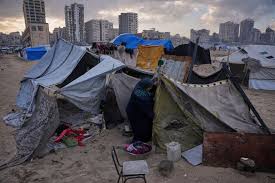
As winter’s biting chill descends upon the Gaza Strip in December 2025, the civilian population finds itself trapped in a harrowing existential dilemma, forced to choose between the suffocating dampness of a soaked tent and the perilous exposure of a bombed-out ruin.
For over two million people, many of whom have been displaced up to ten times, the change in season is not merely a change in weather but an escalation of a humanitarian catastrophe where the “shelter” itself often becomes a death trap.
In the sprawling displacement camps of Al-Mawasi and central Gaza, the reality of living in a tent has become a battle against the elements; recent torrential rains from Storm Byron have flooded approximately 90% of these makeshift sites, turning dirt roads into rivers of mud and sewage.
Parents describe staying awake through the night to bail out freezing water with plastic buckets, while their children sleep on mattresses saturated with contaminated runoff.
The psychological and physical toll of this “tent life” is devastating, as the lack of floors, insulation, or heating leads to a surge in hypothermia, pneumonia, and skin infections, with reports of infants literally freezing to death in their mothers’ arms.
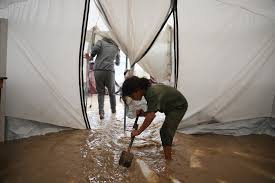
The dampness is all-pervasive, soaking through the few blankets and winter clothes families managed to salvage, leaving them with no way to dry their belongings in the humid, sunless environment. Conversely, the alternative—seeking refuge within the skeletal remains of war-damaged buildings—offers a modicum of solid ground but carries the terrifying risk of structural failure.
Thousands have returned to their neighborhoods in Gaza City and Khan Younis, living in concrete shells where walls have been blown out, and ceilings are held up by twisted, rusted rebar.
These ruins offer no protection against the howling Mediterranean winds, and the weight of the winter rains has caused several “pancaked” floors to finally give way, crushing families who thought they were safer under a concrete roof than a plastic sheet.
Civil defense teams have reported a surge in building collapses, with stones and sand frequently raining down on inhabitants as the moisture-saturated concrete loses its integrity.
Residents describe hearing the “cracking of stones” above their heads as they huddle in corners, using electrical wires as clotheslines and burning toxic plastic scraps just to generate a flicker of warmth. This “grim choice” is exacerbated by the fact that even two months after the October 2025 ceasefire,
essential aid like heavy machinery for rubble removal and “dual-use” reconstruction materials remain heavily restricted at the crossings.
While some winterization kits and high-performance tents have entered, the scale of the need vastly outpaces the supply, leaving nearly 1.5 million people in a state of “permanent temporary” displacement.
The situation is not merely a natural disaster but a man-made crisis where the architecture of war has combined with the cruelty of winter to create a landscape of absolute deprivation.
Whether drowning in the mud of a camp or buried under the rubble of a home, the Gazan people are enduring a winter where the very concept of “home” has been erased, replaced by a desperate, daily calculation of which form of exposure is less likely to be fatal.
About the Author