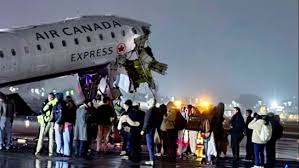
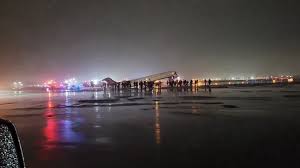
The catastrophic collision between an Air Canada Express Bombardier CRJ-900 and an airport fire truck at New York’s LaGuardia Airport on March 23, 2026, has sent shockwaves through the aviation industry, marking one of the most severe ground incursions in recent memory. The incident occurred shortly before midnight as Flight AC8646, arriving from Montreal, was completing its landing roll on Runway 4.
Preliminary reports and flight-tracking data suggest a disastrous breakdown in communication: while the regional jet was decelerating, a Port Authority fire truck—identified as “Truck 1″—was reportedly attempting to cross the active runway. The resulting impact was devastating, with the aircraft’s nose and forward fuselage sustaining significant structural damage.
High-resolution footage from the scene captured the plane’s nose lifted at an unnatural angle as emergency slides were deployed and passengers began a frantic evacuation onto the rain-slicked tarmac.
The Federal Aviation Administration (FAA) immediately issued a total ground stop, paralyzing operations at one of the nation’s busiest hubs and forcing dozens of diversions as the runway became a massive crime scene and triage center.
The human toll of the accident has been described as significant, with local authorities and emergency responders facing a “mass casualty” scenario.
While official counts are still being finalized, initial reports from the scene indicate that multiple firefighters were trapped in the wreckage of their vehicle, with at least four or five currently listed in critical condition—often referred to as “red tag” patients in emergency protocols.
Among the passengers and crew on board the CRJ-900, more than 100 individuals are being assessed for injuries ranging from severe trauma to smoke inhalation and shock. There are harrowing, though currently unconfirmed, reports of at least two fatalities at the scene.
This tragedy is further complicated by the fact that it occurred during a period of heightened tension and operational strain at U.S. airports, with some reports even citing simultaneous disruptions in TSA screening and staffing.
In the immediate aftermath, the National Transportation Safety Board (NTSB) has launched a full-scale investigation to determine how a rescue vehicle ended up in the direct path of a landing aircraft.
Audio recordings currently being analyzed suggest that air traffic controllers may have issued urgent, last-second commands to both the cockpit and the ground crew to “stop,” but the momentum of the high-speed landing made a collision unavoidable.
The incident has raised critical questions about runway safety technology and the efficacy of “Ground Radar” systems designed to prevent exactly this type of disaster.
As of Monday morning, LaGuardia remains largely shuttered, with a significant probability that the closure will be extended through much of the day as investigators document the debris field.
For the families of those involved and the broader traveling public, the event serves as a chilling reminder of the razor-thin margins of safety that govern the world’s most congested airspace.
About the Author