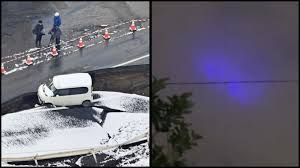
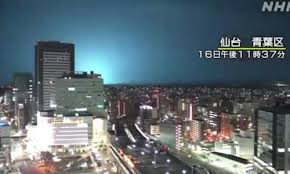
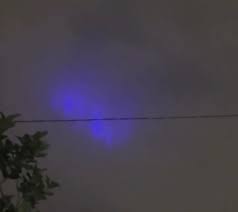
The mysterious blue lights that briefly illuminated the sky over Aomori Prefecture just moments before the powerful Magnitude 7.6 earthquake struck northern Japan on the night of December 8, 2025, have reignited one of seismology’s most perplexing phenomena: Earthquake Lights (EQL). Captured vividly on mobile phones and surveillance footage, the eerie flashes were described by stunned witnesses as sudden, intense pulses of blue and sometimes white light that preceded the ground-shaking.
While some skeptical scientists attribute such sightings to non-seismic factors, such as the explosion of power transformers or electrical arcing caused by the violent shaking of the grid—which often produces blue-green flashes—the timing and remote nature of many historical EQL reports suggest a genuine connection to tectonic activity.
The event in Aomori now adds to a growing body of evidence supporting the existence of this luminous display, which can take various forms, including sheet lightning, floating orbs of light (ball lightning), or a steady glow.
The most widely accepted scientific theory to explain EQLs, though still controversial, is the rock-stress and ionization mechanism. This hypothesis, largely championed by NASA scientist Dr. Friedemann Freund, posits that in certain types of rocks—particularly igneous and metamorphic rocks like basalt and gabbro, which contain tiny crystalline defects known as peroxy bonds—the immense stress and pressure leading up to a major fault rupture cause a chemical-electrical reaction.
This extreme mechanical stress breaks the peroxy bonds, releasing vast quantities of highly mobile, positively charged electrical ‘holes’ (or charge carriers) from deep within the Earth’s crust. These charges travel rapidly to the surface, particularly along subvertical (near-vertical) faults prevalent in rift environments.
Once the positive charge reaches the atmosphere, it quickly ionizes pockets of air, creating a temporary plasma state. It is this plasma, which can emit different colours depending on the gases ionized (blue is often linked to nitrogen and oxygen emissions), that manifests as the visible light phenomenon.
The Aomori earthquake—a thrust faulting event off the coast—has once again thrust this geophysical enigma into the global spotlight. Studies have shown that EQLs are relatively rare, occurring in less than 0.5% of earthquakes worldwide, but are most frequently associated with quakes larger than magnitude 5.0 and those occurring in continental rift zones where the geological structure is conducive to electrical charge propagation.
While the phenomenon is not yet well enough understood to be used for reliable earthquake prediction, the dramatic blue flashes observed in Japan provide fresh, modern video data that researchers will meticulously analyze. Each documented EQL event, as the one witnessed over Aomori, moves the scientific community closer to decoding the exact physico-chemical processes that transform the crushing forces of the Earth’s shifting crust into a fleeting, mysterious spectacle of light in the night sky.
About the Author