On the morning of Wednesday, January 7, 2026, the city of Minneapolis became the flashpoint for a national crisis following the fatal shooting of 37-year-old Renee Nicole Good by an Immigration and Customs Enforcement (ICE) agent during a high-tension federal crackdown known as Operation Metro Surge.
The incident occurred in a snowy residential neighborhood near East 34th Street and Portland Avenue—a location poignantly close to where George Floyd was killed in 2020—and it immediately ignited a fierce debate over federal authority and the use of deadly force.
According to witness accounts and verified video footage, the encounter began when masked federal agents, who were part of a massive 2,000-officer deployment targeting the Twin Cities, approached Good’s burgundy Honda Pilot as it sat in the middle of a roadway.
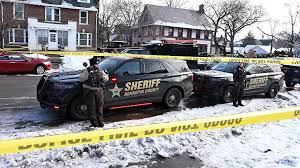
Eyewitnesses described a chaotic scene where agents allegedly gave conflicting orders; while one agent reportedly signaled for the vehicle to move because a federal truck was stuck in a snowbank, another aggressively approached the driver’s side, attempting to open the door.
Residents in the area, who have recently taken to blowing whistles to alert neighbors of ICE activity, watched in horror as the situation escalated in seconds. As the vehicle began to reverse and then move forward, a third agent positioned near the front of the car drew his weapon and fired three shots, striking Good in the head at close range. The vehicle subsequently crashed into a parked car, and though local police and fire officials attempted lifesaving measures, Good was pronounced dead at Hennepin County Medical Center.
In the immediate aftermath, President Donald Trump took to social media to frame the narrative, unequivocally labeling the shooting as an act of “self-defense.” The President asserted that Good had been “very disorderly” and had “viciously ran over” the ICE officer, even suggesting that based on the video clips he viewed, it was “hard to believe” the officer had survived.
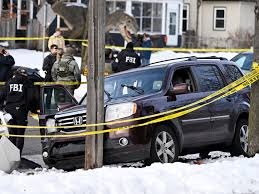
This federal narrative was bolstered by Homeland Security Secretary Kristi Noem, who characterized the driver’s actions as an “act of domestic terrorism” and insisted the agent followed his training to protect his own life and those of his colleagues.
However, this version of events was met with blistering condemnation from local and state leaders. Minneapolis Mayor Jacob Frey, who reported viewing the same video footage, denounced the federal claims as “bullshit” and “garbage,” accusing the agents of recklessly using power and demanding that ICE agents “get the f* out”** of the city immediately. Governor Tim Walz echoed this sentiment, warning the public not to believe the federal “propaganda machine” and calling for a full, fair, and expeditious state investigation to ensure accountability.
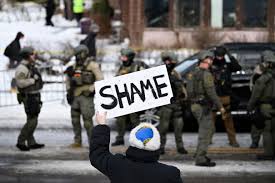
The victim, identified as a U.S. citizen, poet, and mother of a six-year-old, was described by her family as a loving person who was acting as a legal observer for her neighbors, further fueling the outrage of protesters who gathered by the thousands for an evening vigil that lasted late into the night.
This shooting marks a significant and tragic escalation in the Trump administration’s immigration crackdown, which has seen similar federal surges in cities like Los Angeles and Chicago, and has already resulted in over 1,500 arrests in the Minneapolis-St.
Paul has been alone since December. As the city prepares for sustained civil unrest, the death of Renee Nicole Good has come to symbolize the deep fractures in American civil rights and the growing conflict between municipal autonomy and the administration’s aggressive interior enforcement policies, turning a quiet residential street into a site of national mourning and a stark reminder of the escalating human cost within the current immigration battle.
About the Author