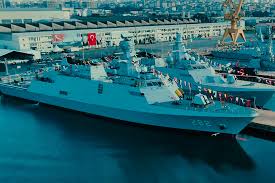
The official commissioning of PNS Khaibar (F-281), the second of four MILGEM-class (Babur-class) corvettes for the Pakistan Navy, on December 20, 2025, represents a landmark achievement in the strategic defense partnership between Islamabad and Ankara.
Held at the Istanbul Naval Shipyard, the ceremony was graced by Turkish President Recep Tayyip Erdoğan and Pakistan’s Chief of Naval Staff, Admiral Naveed Ashraf, highlighting a collaboration that Erdoğan described as an “exemplary brotherhood” destined to endure “until the end of time
.” This vessel is a sophisticated derivative of the Turkish Navy’s Ada-class corvette, specifically tailored to meet Pakistan’s unique operational requirements in the North Arabian Sea and the broader Indian Ocean.
With a full-load displacement of approximately 2,900 to 3,000 tonnes and a length of 108.8 meters, PNS Khaibar is classified as a multi-role guided-missile heavy corvette, designed to execute anti-surface, anti-air, and anti-submarine warfare missions with high autonomy.
The ship is powered by a Combined Diesel and Gas (CODAG) propulsion system, featuring a single General Electric LM2500 gas turbine and two MTU diesel engines, allowing it to reach top speeds exceeding 29 knots while maintaining an operational range of over 3,500 nautical miles.
What sets the Pakistani variant apart from its Turkish counterparts is its heavily upgraded armament package, which prioritizes “sea denial” and long-range strike capabilities.
Central to its lethality is the integration of a 16-cell Vertical Launch System (VLS) housed on the forward deck, typically armed with the CAMM-ER (Albatross NG) surface-to-air missiles for robust point and area defense against high-speed aerial threats. For surface engagements, the corvette is equipped with six launchers for the indigenous Harbah anti-ship and land-attack cruise missiles, providing the Pakistan Navy with a formidable standoff strike capability.
The ship’s defensive suite is rounded out by a 76mm Leonardo Super Rapid main gun, the Turkish-made Aselsan Gökdeniz 35mm Close-In Weapon System (CIWS) for terminal defense, and two 25mm remote weapon stations.
Beyond its physical weaponry, PNS Khaibar serves as a high-tech sensor platform, utilizing the GENESIS MİLGEM (G-MSYS) Combat Management System to fuse data from its Aselsan 3D air-search radar, SMART-S Mk 2 search radar, and the Yakamos hull-mounted sonar.
The commissioning of this ship marks the successful completion of the construction phase in Turkey, following the delivery of the lead ship, PNS Babur, in late 2023.
The project, initiated under a $1.5 billion contract signed in 2018 with the Turkish state-owned firm ASFAT, is notable for its extensive Transfer of Technology (ToT) component.
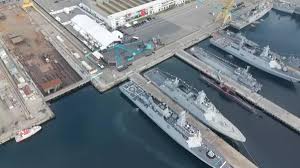
While the first two ships were built in Istanbul, the remaining two vessels—PNS Badr and PNS Tarik—are currently under construction at the Karachi Shipyard & Engineering Works (KS&EW) in Pakistan.
This arrangement not only bolsters Pakistan’s immediate naval deterrence against regional rivals but also strengthens its domestic shipbuilding industry, moving the country toward greater military self-reliance.
As PNS Khaibar prepares to join the fleet, its induction is viewed by maritime analysts as a critical move to safeguard the China-Pakistan Economic Corridor (CPEC) sea lanes and ensure the security of Pakistan’s Exclusive Economic Zone (EEZ) amid intensifying maritime competition in South Asia.
The vessel’s ability to operate in a network-centric environment, combined with its stealthy hull design and advanced electronic warfare suites, makes it one of the most capable surface combatants in the region, effectively bridging the gap between traditional corvettes and modern frigates.
About the Author