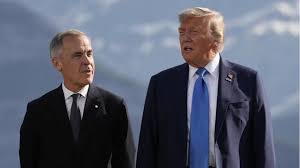
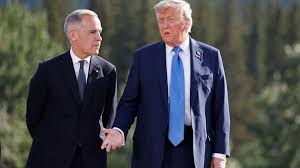
In January 2026, the trade relationship between the United States and Canada reached a boiling point after President Donald Trump threatened to impose 100% tariffs on all Canadian imports. The ultimatum was triggered by Canadian Prime Minister Mark Carney’s recent visit to Beijing, where he secured a “preliminary, but landmark” trade agreement to reduce barriers between Canada and China. Trump, communicating via Truth Social, warned that Canada was positioning itself as a “drop-off port” for Chinese goods to circumvent U.S. trade restrictions, famously declaring that “China will eat Canada alive” if the deal proceeds.
Economic and Geopolitical Friction
The friction stems from a pivot in Canadian trade policy. Earlier in the month, Prime Minister Carney reached a deal with Chinese leader Xi Jinping to lower tariffs on Canadian agricultural exports—such as canola and lobster—in exchange for Canada reducing its 100% surtax on Chinese electric vehicles (EVs). Under the new arrangement, Canada would allow a quota of roughly 49,000 Chinese EVs at a significantly lower tariff rate of 6.1%. Trump viewed this as a direct betrayal of his administration’s efforts to isolate the Chinese economy and a threat to the U.S. automotive industry.
The War of Words
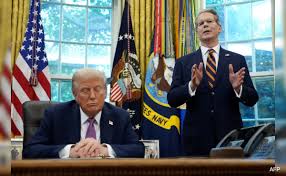
The trade threat is inseparable from a broader, more personal feud between Trump and Carney:
The “Governor” Insult: Trump has repeatedly referred to Carney as “Governor Carney,” a rhetorical swipe implying Canada should be treated as a 51st U.S. state rather than a sovereign nation.
The Greenland Dispute: Tensions were already high after Carney criticized Trump’s renewed push to acquire Greenland, describing the move as a “rupture” in the global order during a speech at the World Economic Forum in Davos.
Retaliation: Following Carney’s Davos remarks, Trump revoked an invitation for Canada to join his newly formed “Board of Peace,” an international body intended to resolve global conflicts.
Potential Consequences
If enacted, a 100% tariff would be catastrophic for the North American economy. Canada is the largest foreign supplier of crude oil, steel, and aluminum to the U.S. Midwest. Economists warn that such a move would shatter the CUSMA (Canada-U.S.-Mexico Agreement), which is already scheduled for review later this year. While Canadian officials like Trade Minister Dominic LeBlanc have clarified that Canada is not pursuing a full Free Trade Agreement with China, the Trump administration remains steadfast that any “leakage” of Chinese goods through the northern border will be met with maximum economic pressure.
About the Author