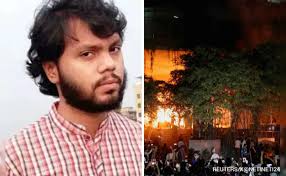
The political landscape of Bangladesh has been plunged into a state of severe unrest following the death of Sharif Osman Hadi, a 32-year-old youth leader and a pivotal figure of the 2024 July Uprising. Hadi, who served as the convener of the influential Inqilab Mancha platform, passed away on Thursday, December 18, 2025, while undergoing treatment at a hospital in Singapore.
He had been battling for his life for six days after being shot in the head by masked assailants on a motorbike in Dhaka’s Bijoynagar area on December 12.
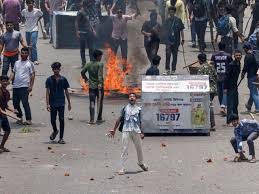
At the time of the attack, Hadi was actively campaigning as an independent candidate for the upcoming national elections scheduled for February 12, 2026. His death has acted as a lightning rod for simmering tensions, sparking a wave of “explosive” violence that has paralyzed major cities, including Dhaka, Chattogram, and Rajshahi.
A Night of Arson and Media Targeting
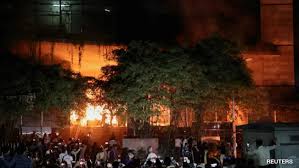
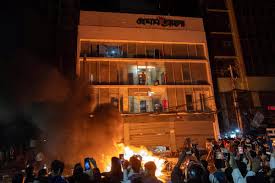
The news of Hadi’s demise triggered immediate and violent repercussions across the capital. Overnight, angry mobs converged on the offices of the country’s two largest newspapers, Prothom Alo and The Daily Star, accusing them of maintaining a pro-India bias and failing to support the “revolutionary spirit” of the youth.
In a terrifying escalation, protesters set fire to both buildings in the Karwan Bazar area, trapping dozens of journalists inside as smoke filled the corridors. Visuals from the scene showed demonstrators looting office equipment and chanting slogans like “Who are you, who am I – Hadi, Hadi!”
The violence was not limited to media houses; the partially demolished residence of the nation’s founding father, Sheikh Mujibur Rahman, at 32 Dhanmondi, was once again vandalized and set ablaze, with protesters tearing down posters of the ousted former Prime Minister Sheikh Hasina.
Escalating Diplomatic Tensions with India
The unrest has taken a sharp anti-India turn, with protesters alleging that Hadi’s assassins fled across the border to seek refuge. In Chattogram, a massive crowd surrounded the residence of the Indian Assistant High Commissioner at 1:30 AM, hurling bricks and stones at the diplomatic facility.
While the premises remained intact due to a heavy police and army presence, the incident has forced New Delhi to shut down two more visa centers in Bangladesh, citing “unavoidable further straining the fragile bilateral ties between the Muhammad Yunus-led interim government and the Indian administration.
The Government’s Response and Future Outlook
In a somber televised address to the nation, Chief Adviser Muhammad Yunus characterized Hadi’s death as an “irreparable loss to the nation’s democratic march.” He declared Saturday, December 20, 2025, a day of state mourning, with the national flag to be flown at half-mast across all government buildings.
Yunus promised a transparent and swift investigation, vowing that “no leniency” would be shown to the perpetrators. However, the political atmosphere remains volatile as the Bangladesh Nationalist Party (BNP) prepares for the high-profile return of Tarique Rahman from exile on December 25.
With the general elections just weeks away, the death of a “frontline fighter” like Hadi has raised serious questions about the safety of political candidates and the ability of the interim administration to maintain law and order during this transition.
About the Author