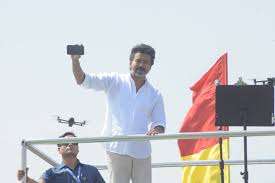
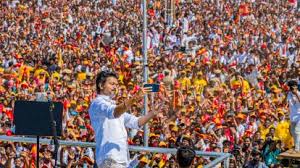
In his quest to dismantle the political dominance of the Dravida Munnetra Kazhagam (DMK) ahead of the 2026 Tamil Nadu Assembly elections, actor-turned-politician Vijay has strategically adopted a rhetorical and ideological blueprint pioneered by the late J. Jayalalithaa.
At a massive public meeting in Erode on December 18, 2025, the leader of the Tamilaga Vettri Kazhagam (TVK) made headlines by explicitly labeling the DMK as a theeya sakthi (evil force)—a sharp, polarizing phrase that was the hallmark of Jayalalithaa’s political career.
By resuscitating this specific terminology, Vijay is not merely launching a critique; he is positioning himself as the primary anti-DMK pole, a space left largely vacant and fragmented since the passing of the “Iron Lady” of Tamil Nadu.
This move is a calculated departure from other new political entrants who typically attack both major Dravidian parties; instead, Vijay has chosen to validate the AIADMK’s historical grievances while attempting to inherit its core anti-DMK voter base.
Vijay’s borrowing from Jayalalithaa extends beyond just vocabulary; it involves a sophisticated appropriation of political legacy. During his speech, he argued that while he respects icons like Periyar and Annadurai, no single party has a monopoly over them, much like Jayalalithaa often asserted her right to the Dravidian throne against M. Karunanidhi.
He framed the 2026 election as a binary battle between the “evil” DMK and his own “pure” TVK, mirroring the high-stakes, “us-vs-them” morality plays that Jayalalithaa used to galvanize her supporters.
By specifically invoking her name alongside M.G. Ramachandran (MGR), Vijay is signaling to the disillusioned AIADMK cadres that he understands their struggle and is prepared to be the “enforcer” of their ideals.
This strategy effectively bypasses the current AIADMK leadership, presenting Vijay as the natural successor to the charismatic, populist style of governance that defined the Jayalalithaa era.
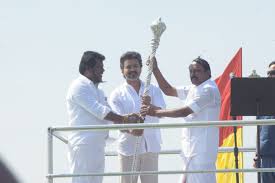
Furthermore, Vijay has mirrored Jayalalithaa’s approach to welfare and gender-centric politics. Much like the former Chief Minister, who fiercely defended her “Amma” schemes against labels of being “freebies,” Vijay used his Erode rally to condemn the DMK for calling people’s welfare “OC” (free/worthless).
He framed governance as a duty to the motherly and marginalized figures of society, using emotional anecdotes—such as the story of a mother funding a local canal—to build a persona of a protective, son-like leader.
This “protective populism” was a central pillar of Jayalalithaa’s mass appeal. By blending this mother-centric sentiment with a harsh, uncompromising stance on DMK “corruption and dynastic rule,”
Vijay is attempting to replicate the winning formula that kept the DMK out of power for ten consecutive years. He is betting that by speaking the “language of Jayalalithaa,” he can convert a fan base into a political movement that feels both familiar and refreshingly new to the Tamil electorate.
About the Author