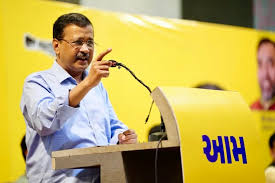
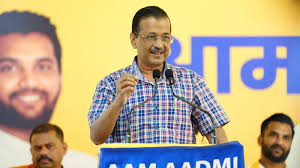
Aam Aadmi Party (AAP) National Convener Arvind Kejriwal recently amplified the political significance of the ongoing Hadadad agitation in Gujarat, declaring during a visit to Rajkot that the farmers’ protest would soon evolve into a momentous ‘BJP Quit Gujarat’ movement.
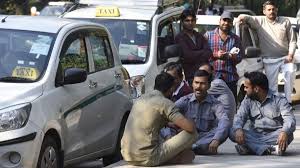
The Hadadad agitation, which began with a ‘kisan mahapanchayat’ in Botad on October 12 to demand the abolition of the ‘kadada pratha’ (a local farming-related practice or regulation), escalated into violence where police employed lathicharge and tear gas, leading to the arrest of dozens of AAP workers and local residents on serious charges, including attempt to murder and rioting. Kejriwal’s trip to Rajkot was specifically to meet the relatives of those booked and still in judicial custody, including prominent AAP leaders like Pravin Ram and Raju Karpada.
By drawing a powerful parallel with Mahatma Gandhi’s historic 1942 call of ‘Angrezo, Bharat Chhodo’ (British, Quit India), Kejriwal framed the local grievance as a widespread revolt against the current ruling party, attempting to project the AAP as the singular political vehicle for this anti-incumbency sentiment.
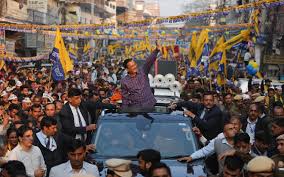
Kejriwal’s address leveraged the emotional resonance of the arrests and the alleged police repression, portraying the detained individuals not as lawbreakers but as martyrs for the cause of poor farmers across Gujarat.
He highlighted the police action, which saw 88 people arrested and many kept in jail for months on what he termed “false FIRs,” as a symbol of the arrogance of a party that has ruled the state for three decades and now believes it is untouchable.
By meeting the families and promising to secure the release of all those still in custody—even vowing that all false cases would be closed within 24 hours of an AAP government taking power—Kejriwal sought to directly challenge the state’s use of force and judicial process against protestors.
He passionately argued that the farmers are not just fighting for themselves but for the fundamental rights of all Gujuratis, whose fear of the ruling establishment, he claimed, is finally starting to erode.
This strategic move places the AAP firmly in the leadership of a major protest movement, allowing them to reposition themselves as the true alternative to the long-dominant BJP, contrasting with the Congress party which he accused of being in collusion with the BJP. Kejriwal’s message was a stark call to political action: the bravery shown in the agitation must be translated into votes to finally “chase BJP out of Gujarat,” thus linking the localized issue of the kadada pratha and police brutality to the larger goal of political regime change. The former Delhi Chief Minister’s strong rhetoric, which also touched upon the widespread issues of illicit liquor and drug proliferation, was a direct attack on the governance record of the BJP, aiming to consolidate the popular discontent into a unified movement for the upcoming state elections.
About the Author