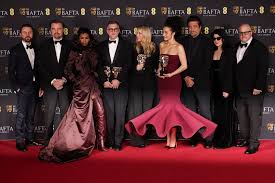

At the 79th British Academy Film Awards (BAFTA), held on Sunday, February 22, 2026, Paul Thomas Anderson’s sprawling counterculture epic, “One Battle After Another,” emerged as the night’s undisputed champion, securing a staggering six trophies.
Staged at London’s Royal Festival Hall and hosted by the charismatic Alan Cumming, the ceremony cemented the film’s status as a frontrunner for the upcoming Oscars.
Loosely adapted from Thomas Pynchon’s 1990 novel Vineland, the film—which Anderson wrote, directed, and produced—captured the prestigious Best Film prize and earned Anderson the Best Director and Best Adapted Screenplay honors.
The technical mastery of the production was also recognized, with wins for Michael Bauman in Cinematography and Andy Jurgensen in Editing, highlighting the film’s unique visual style, which was shot on the rare and expensive VistaVision format.
A Cinematic Triumph and Emotional Tributes
The narrative of “One Battle After Another” is a high-octane blend of black comedy and action-thriller, following a washed-up former revolutionary and explosives expert, “Ghetto” Pat Calhoun (played by Leonardo DiCaprio), who must emerge from a paranoid, off-grid retirement to save his daughter from a ruthless military pursuer.
The film’s victory was punctuated by an emotional and deeply personal acceptance speech from Anderson. While accepting the Best Director award, he delivered a moving tribute to his long-time collaborator and producer,
Adam Somner, who passed away during the film’s production in 2024. Anderson described Somner as one of Britain’s greatest cinematic exports, noting that his presence on set, even while ill, reminded the entire crew of the privilege of storytelling. This raw, human moment resonated throughout the hall, bridging the gap between Hollywood’s blockbuster scale and the intimate artistry Anderson is known for.
Sean Penn’s Chilling Victory
In one of the night’s most talked-about “upsets,” Sean Penn won the BAFTA for Best Supporting Actor for his portrayal of the villainous Colonel Steven J. Lockjaw. Penn, who was not in attendance to collect the mask, was praised by critics for creating a “terrifyingly modern” antagonist—a reactionary military figure described as a mix between a “roided-up Colonel Kurtz” and a bureaucratic nightmare.
His win was particularly notable as he beat out stiff competition from fan favorites like Paul Mescal (Hamnet) and Jacob Elordi (The Fault in Our Stars). Although Leonardo DiCaprio was nominated for Best Leading Actor, he ultimately lost to the night’s “feel-good” winner, Robert Aramayo, who delivered a powerhouse performance in the British biopic I Swear. Despite this, the ensemble cast of “One Battle After Another”—which includes Benicio del Toro, Regina Hall, and Teyana Taylor—was hailed as the backbone of the film’s success.
Competition and the Road to the Oscars
While Anderson’s film dominated the count, it shared the spotlight with other significant winners that reflected a diverse year in cinema. Ryan Coogler’s vampire thriller Sinners took home three awards, including Best Original Screenplay, making Coogler the first Black filmmaker to win in that category.
Meanwhile, Chloé Zhao’s Hamnet was honored as the Outstanding British Film, with its lead, Jessie Buckley, winning Best Leading Actress. However, the sheer momentum of “One Battle After Another” suggests a “sea change” in the awards race.
Having already swept the Golden Globes and the Critics’ Choice Awards, the film’s six-BAFTA haul signals that Anderson’s most expensive and ambitious project to date is not just a critical darling but a definitive cultural moment. As the industry looks toward Hollywood, “One Battle After Another” stands as a testament to the power of uncompromising, auteur-driven filmmaking on a grand scale
About the Author