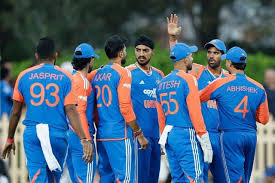
The ongoing India vs. South Africa T20I series in December 2025 has brought a fascinating tactical dilemma to the forefront: the “Bowler’s Paradox.” While India arguably possesses the most lethal bowling quartet in world cricket with Varun Chakaravarthy,
Kuldeep Yadav, Arshdeep Singh, and Jasprit Bumrah, the reality of modern white-ball cricket makes fielding all four in the same eleven a high-stakes gamble that team management is often unwilling to take.
The primary reason for this restriction is the non-negotiable requirement for batting depth. In the current T20 template pioneered by the likes of England and refined by Gautam Gambhir’s India, a “tail” that starts at number eight is considered a strategic liability.
Because none of these four specialist bowlers are reliable contributors with the bat, their simultaneous inclusion would leave India with a “fragile tail,” making the top-order batters more cautious and prone to collapsing under pressure.
The Batting Depth Crisis
In the high-scoring environments of 2025, a competitive T20 side needs a “bankable” batter at the number 8 position—someone like Axar Patel, Washington Sundar, or even Harshit Rana—who can strike at a rate of 150+ and clear the ropes.
If India plays Bumrah and Arshdeep as the primary pacers and pairs them with both Kuldeep and Varun, the batting effectively ends at number seven (usually occupied by Hardik Pandya or Shivam Dube).
On South African pitches, which often offer extra bounce and lateral movement, even a minor top-order stumble could lead to a total collapse if there is no cushion in the lower-middle order.
Historical data, such as India’s narrow loss at the MCG in October 2025, showed that when the top six failed, the lack of a batting all-rounder at number eight prevented the team from even reaching a defensible total.

Tactical Overlap and Redundancy
Beyond the batting concerns, there is the issue of tactical redundancy. Both Varun Chakaravarthy and Kuldeep Yadav are middle-overs “enforcers.”
While their skill sets differ—Varun offers mystery and over-spin that is effective even on dewy nights, while Kuldeep provides the traditional flight and guile of a left-arm wrist-spinner—they occupy the same strategic real estate.
In South Africa, where pitches generally favor pace and bounce, playing two specialist spinners who don’t bat is often viewed as “over-indexing” on spin. Team management typically prefers a combination of three pacers and one specialist spinner, or two pacers and two spinners (where one is an all-rounder like Axar).
The South African Conditions Factor
Specifically in the South African context, the “Dhurandhar Effect”—a term now used by cricket analysts to describe a relentlessly aggressive bowling attack—is better achieved by balancing pace and spin.
With Jasprit Bumrah and Arshdeep Singh securing the “top and tail” of the innings (the powerplay and the death overs), the middle-overs slot is a battle between Varun and Kuldeep. Varun has recently edged ahead in the pecking order due to his ability to remain economical on flatter, truer surfaces,
whereas Kuldeep is often reserved for drier tracks like those seen in the Asia Cup. To play both, India would have to sacrifice a third seaming option, which is a dangerous move on the fast tracks of Gqeberha or Johannesburg, where the extra pace of a Harshit Rana or a bowling-fit Hardik Pandya is essential to exploit the conditions.
Ultimately, the exclusion of one of these “Fab Four” is not a reflection of their individual talent, but a sacrifice for team balance. Until one of the specialist spinners develops the power-hitting capabilities of a Rashid Khan,
About the Author