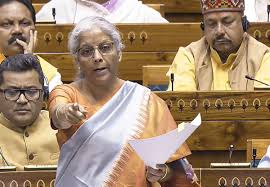
A sharp exchange erupted in the Lok Sabha when Union Finance Minister Nirmala Sitharaman strongly rebuked Trinamool Congress (TMC) MP Saugata Roy for objecting to her speaking in Hindi during The discussion regarding the Health Security and National Security Cess Bill.
The incident occurred when Roy, a veteran MP from West Bengal, interjected during his speech to remark that he had struggled to follow the Minister’s earlier presentation on the Bill because it was delivered in Hindi. He stated, “Nirmala ji also spoke in Hindi.
I could not follow what she said because we are Bengalis; we don’t follow so much of Hindi.” This brought an immediate and firm intervention from the Chair, Jagdambika Pal, who pointed out that the House was equipped with live translation facilities and that the proceedings were accessible in multiple languages, including on the Parliament app. Roy doubled down, replying, “We are Bengalis, and we will remain Bengalis,” prompting the Chair to caution him, emphasizing that he could not speak of the national language in such a manner in the House.
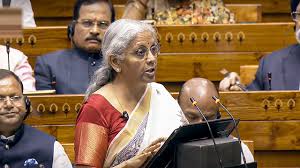
Intervening directly in the debate, a visibly agitated Sitharaman lashed out at the objection, questioning the fundamental premise of Roy’s complaint I can communicate in Hindi, I can communicate in Tamil, I can communicate in Telugu, I can communicate in English.
How does it matter to the honourable member?” she asked pointedly, leveraging her own multilingual background. She stressed that the purpose of Parliament’s advanced translation system, available to every member, was precisely to ensure that language was never a barrier to understanding a Bill.
The Minister further suggested that Roy’s objection was a deliberate tactic to divert attention from the substance of the Bill, which aims to create a dedicated resource stream for critical national priorities. She took strong objection, asking for her protest to be officially placed on record, effectively asserting the right of any member to use any of the constitutionally recognised Indian languages in Parliamentary debate without facing an arbitrary linguistic barrier. The exchange underscored the persistent political tension surrounding language, federalism, and legislative proceedings in India’s Parliament.
About the Author