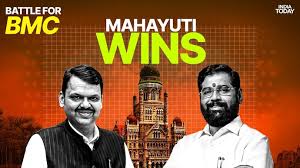
The Brihanmumbai Municipal Corporation (BMC) elections of January 2026 have marked a tectonic shift in Maharashtra’s political landscape, signaling the end of an era that lasted nearly three decades. For the first time in over 25 years, the Thackeray family has lost its grip on India’s richest civic body, as the BJP-led Mahayuti alliance secured a decisive majority.
In a high-stakes battle that many described as a “showdown” for regional supremacy, the Bharatiya Janata Party (BJP) emerged as the single largest party, winning 89 seats, while its ally, the Eknath Shinde-led Shiv Sena, bagged 29 seats. Together, the alliance crossed the magic figure of 114 in the 227-member house with a combined total of 118 seats.
This victory represents a personal triumph for Chief Minister Devendra Fadnavis and Deputy Chief Minister Eknath Shinde, who successfully executed a “Mission Mumbai” strategy designed to dismantle the Thackeray “bastion” through a combination of aggressive infrastructure development and a calculated split of the traditional Marathi vote bank.
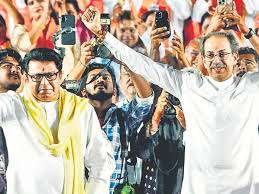
Conversely, the Shiv Sena (Uddhav Balasaheb Thackeray) faction managed to secure 65 seats, proving that while Uddhav Thackeray remains a potent force with a loyal core base, the loss of the party name, the original “bow and arrow” symbol, and the organizational machinery to the Shinde faction has finally taken its toll on his ability to govern the city’s massive resources.
The much-touted “reunion of the cousins”—an informal tactical understanding between Uddhav Thackeray and Raj Thackeray’s MNS (which won only 6 seats)—failed to create the “Marathi Asmita” wave required to stop the Mahayuti juggernaut.
Other major players, including the Congress (24 seats) and the AIMIM (8 seats) saw mixed results, with the latter making surprising gains in minority-dominated pockets, further complicating the opposition’s math.
The significance of this loss for the Thackeray family cannot be overstated. The BMC is not merely a municipal entity; it is the financial lifeline of Mumbai, boasting an annual budget exceeding ₹74,400 crore—larger than that of several small Indian states.
For decades, the undivided Shiv Sena used the BMC as its primary source of political and financial patronage, building a grassroots network of “shakhas” that provided essential services to citizens.
By wresting control of this “gold mine,” the BJP and the Shinde Sena have effectively cut off the Thackeray faction’s most vital resource base, leaving the Shiv Sena (UBT) to face its most severe existential crisis since its inception in 1966.
The Mahayuti’s campaign focused heavily on the narrative of a “Triple Engine Sarkar,” arguing that having the same ruling parties at the Center, the State, and now the Civic level would accelerate mega-projects like the Mumbai Coastal Road, the Navi Mumbai International Airport, and the expanded Metro network.
This “pro-development” pitch resonated with a broad spectrum of voters, including the Marathi middle class, Gujaratis, and North Indians, who were seemingly weary of the “obstructionist” politics and administrative delays that had characterized the BMC’s recent years under administrative rule.
As the saffron flag of the BJP-Shinde combine flies over the BMC headquarters at Fort, the result confirms that the “Thackeray brand,” while still respected, no longer holds an exclusive monopoly over the identity of Mumbai.
About the Author