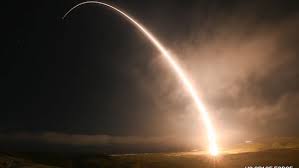
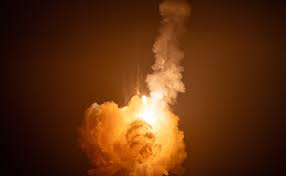
On March 3, 2026, at precisely 11:01 p.m. Pacific Time, the United States Air Force Global Strike Command successfully conducted a high-stakes test launch of an unarmed LGM-30G Minuteman III intercontinental ballistic missile (ICBM) from Vandenberg Space Force Base in California. This mission, designated Glory Trip 255 (GT 255), saw the nuclear-capable “doomsday” missile soar across the Pacific Ocean, traveling more than 4,200 miles before its two test reentry vehicles struck a predetermined target at the Kwajalein Atoll in the Marshall Islands.
While the Pentagon maintains that the test was a “routine” operation scheduled years in advance and not a direct response to current world events, the timing is undeniably provocative, occurring just days after the US and Israel launched Operation Epic Fury—a massive military offensive aimed at dismantling Iran’s nuclear infrastructure.
The launch took place as the world grapples with the fallout of the sinking of the IRIS Dena, an Iranian frigate destroyed by a US submarine, and the subsequent threats of “Quiet Death” in the Indian Ocean. This particular test was unique for its deployment of multiple reentry vehicles, a capability intended to overwhelm enemy missile defense systems, signaling a significant shift in US nuclear posture following the expiration of the New START arms control treaty in February 2026. General S.L. Davis, commander of Air Force Global Strike Command, emphasized that the test validated the “intricate synchronization” required to deliver independently targeted payloads with absolute precision.
Adding to the gravity of the event, the launch was triggered from an E-6B Mercury, commonly known as the “doomsday plane,” which serves as a flying command center capable of transmitting launch orders even if ground-based communications are annihilated in a nuclear exchange.
Defense Secretary Pete Hegseth and Secretary of State Marco Rubio have both underscored that such tests are essential to maintaining the land-based leg of the nuclear triad as a credible deterrent against adversaries like Iran and Russia, who are perceived to be exploiting the vacuum left by collapsed diplomatic frameworks.
As the war with Iran rages and the Middle East remains a “powder keg,” the sight of a Minuteman III streaking through the night sky at Mach 23 serves as a grim reminder of the ultimate stakes of 21st-century conflict. The missile, which has been the backbone of American deterrence since 1970, is currently slated for replacement by the LGM-35A Sentinel, but delays in that program mean the aging Minuteman III must remain “mission-ready” well into the 2030s.
For observers in Colombo, Tehran, and Moscow, GT 255 was far more than a technical evaluation; it was a loud, kinetic demonstration of American resolve during a week when the specter of global war feels increasingly tangible. The data gathered by the 377th Test and Evaluation Group will now be used to refine the reliability of the 400 ICBMs currently on alert across Montana, North Dakota, and Wyoming, ensuring that the nation’s “last resort” remains functional.
Ultimately, as Iran retaliates by seizing the Strait of Hormuz and local morgues in Sri Lanka deal with the human cost of naval skirmishes, the Vandenberg launch reinforces a terrifying reality: the line between “routine” deterrence and active wartime preparation has become dangerously blurred, placing the global community on a knife-edge as the superpowers signal their readiness for the unthinkable.
About the Author