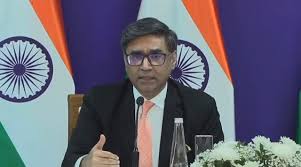
In January 2026, India’s Foreign Secretary Vikram Misri clarified that the nation’s defense procurement strategy remains rooted in pragmatic national interest rather than political ideology. This statement came in response to remarks made by German Chancellor Friedrich Merz during his landmark visit to India on January 12–13, 2026. Chancellor Merz, framing the partnership as a “strategic necessity,” explicitly suggested that deeper security ties with Germany and Europe would help New Delhi reduce its long-standing dependence on Russian military hardware. However, New Delhi’s pushback underscores its long-held principle of strategic autonomy, signaling to both the West and Moscow that India will not be “leveraged” into choosing sides, even as it aggressively diversifies its arsenal.
The “Submarine Offer” and Technical Cooperation
The centerpiece of this diplomatic exchange is a massive $8.3 billion (₹70,000 crore) deal for six advanced conventional submarines under Project-75(I). Germany’s ThyssenKrupp Marine Systems (TKMS), in partnership with Mazagon Dock Shipbuilders (MDL), has moved to the forefront by offering:
Full Technology Transfer (ToT): Berlin has reportedly agreed to a 100% transfer of design and production know-how, including the critical fuel-cell-based Air-Independent Propulsion (AIP) system.Co-Production: Unlike previous “black box” exports, this deal envisions the submarines being built entirely in India, supporting the Aatmanirbhar Bharat (Self-Reliant India) initiative.Aero-Engine Collaboration: Beyond the seas, Germany’s MTU is collaborating with France’s Safran and India’s DRDO on the engine for the AMCA 5th Gen Stealth Fighter, providing a European alternative to American or Russian propulsion systems.
A Shift in German Policy
For decades, Germany maintained a restrictive stance on defense exports to non-NATO countries. However, the “Zeitenwende” (turning point) in German foreign policy—triggered by the Ukraine conflict—has seen Berlin simplify its export clearance processes for India. Prime Minister Modi expressed “heartfelt gratitude” to Chancellor Merz for these regulatory changes, noting that they symbolize a new era of mutual trust. By 2026, the cumulative value of India-Germany defense cooperation is expected to exceed $25 billion, driven by shared concerns over “rough winds” in global politics and the need for resilient, trusted supply chains.
Conclusion: Interests Over Ideology
While Chancellor Merz pitched the deal as a way to pivot away from Russia, India’s response was a calculated reminder of its “multi-aligned” status. Foreign Secretary Misri noted that sourcing decisions are influenced by technical requirements, cost, and technology transfer—not by a desire to align with a specific ideological bloc. For India, the German offer is not about making a geopolitical statement, but about acquiring high-end technology that its domestic industry has yet to master, such as advanced submarine hulls and stealth-capable jet engines.
About the Author