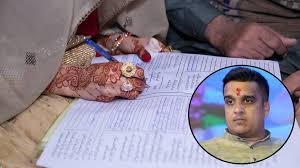

In a move that has ignited a fierce national debate over the boundary between state protection and individual liberty, the Gujarat government officially proposed a series of sweeping amendments to the Gujarat Registration of Marriages Act, 2006, on February 20, 2026. Tabling the proposal in the State Assembly under Rule 44, Deputy Chief Minister Harsh Sanghavi explicitly linked the need for stricter regulations to the controversial phenomenon of “love jihad,” characterizing it as a “cultural invasion” that exploits existing legal loopholes to deceive young women.
The proposed rules seek to fundamentally dismantle the current system of “quick” registrations by making parental notification—and effectively, their consent—central to the legal recognition of a union. Under the draft guidelines, any couple seeking to register their marriage must now submit a formal declaration stating whether they have informed their parents.
More significantly, the Assistant Registrar is mandated to officially notify the parents of both the bride and the groom within 10 working days of receiving the application, using both electronic means like WhatsApp and physical notices.
The process further introduces a mandatory 30 to 40-day “cooling-off” period before a certificate can be issued, a duration intended to allow for verification, parental consultation, or the filing of objections. Sanghavi’s rhetoric in the Assembly was pointed, citing instances in the Panchmahal district where “nikah” certificates were allegedly issued in villages without a single Muslim resident or mosque, and warning that “any Salim masquerading as a Suresh” to trap innocent girls would be “taught a lesson for life.”
The legislative push is not an isolated political whim but the culmination of years of sustained pressure from influential community groups, including the Patidar and Kshatriya Thakor organizations, who have long argued that “love marriages” (locally termed bhagedu lagan or elopement) destabilize the social fabric and leave parents emotionally and legally helpless.
Supporters of the move, including some opposition voices like Congress MP Geniben Thakor, argue that 99% of elopements end in misery and that parental involvement serves as a necessary “safety mechanism” against fraud and coercion.
However, legal experts and civil rights activists have responded with alarm, noting that the requirement flies in the face of decades of jurisprudence. The Supreme Court of India has repeatedly affirmed in landmark cases like Lata Singh v.
State of UP and Shafi Jahan v. KM Ashokan that once two individuals reach the age of majority, their right to marry a person of their choice is an inextricable part of Article 21 (the Right to Life and Personal Liberty) and does not require the “consent of the family, community, or clan.”
Critics argue that by creating a state-sanctioned mechanism to alert parents—who are often the primary source of opposition or even violence in inter-caste and inter-faith unions—the government is effectively weaponizing the registration process to curb personal agency.
As Gujarat opens a 30-day window for public feedback on these draft rules, the state finds itself at a constitutional crossroads: trying to reconcile the “Sanatan traditions” cited by the Deputy CM with the individualistic freedoms guaranteed by a modern democracy. Whether these rules can survive the inevitable “judicial scrutiny” Sanghavi himself acknowledged remains the million-dollar question for the thousands of couples currently caught in the crosshairs of this legislative shift.
About the Author