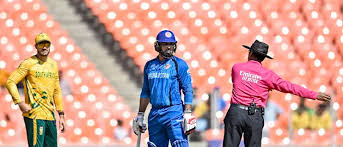
On February 12, 2026, the International Cricket Council (ICC) officially announced sanctions against veteran Afghanistan all-rounder and former captain Mohammad Nabi following a heated confrontation during a high-stakes T20 World Cup clash against South Africa.
The incident occurred on Wednesday night at the Narendra Modi Stadium in Ahmedabad during a Group D match that is already being hailed as one of the most dramatic in the tournament’s history. Nabi was found to have breached Article 2.4 of the ICC Code of Conduct, which pertains to “disobeying an umpire’s instruction during an international match.
” As a result, the 41-year-old was fined 15% of his match fee and handed one demerit point, marking his first disciplinary offence in the current 24-month period. The penalty was proposed by match referee David Gilbert and accepted by Nabi, bypassing the need for a formal hearing.
The “Wristband” Conflict
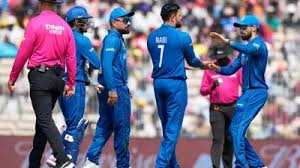
The controversy erupted at the start of the 14th over of Afghanistan’s run chase. As South African pacer Lungi Ngidi prepared to bowl, Nabi, who was on strike, halted the game to register a formal complaint regarding a bright yellow wristband Ngidi was wearing. Nabi argued vehemently that the accessory’s colour was a direct distraction, as it matched the fluorescent hue of the white Kookaburra ball used in T20 cricket, making it nearly impossible to pick up the ball’s release point from the bowler’s hand.
When on-field umpire Jayaraman Madanagopal informed Nabi that the equipment had been cleared by officials and was not a violation of the laws, the Afghan veteran refused to resume his batting stance. The situation escalated into a prolonged, five-minute argument involving both on-field umpires and South African captain Aiden Markram, who reportedly accused Nabi of tactical time-wasting.
A Night of Double Super Overs
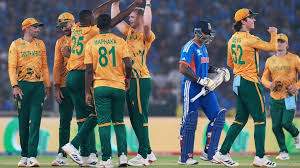
The disciplinary incident was just one chapter in an evening of unprecedented cricketing chaos. After both teams finished their allotted 20 overs tied at 187 runs, the match pushed into a double Super Over—a rare occurrence on the world stage. In the first Super Over, Afghanistan managed 17 runs, which South Africa matched thanks to a last-ball boundary by Tristan Stubbs.
In the second tie-breaker, the Proteas set a formidable target of 24 runs. While Rahmanullah Gurbaz kept Afghan hopes alive with a flurry of sixes, the team eventually fell four runs short. For Nabi, the night ended in double disappointment; shortly after his confrontation with the officials, he was dismissed for just five runs, with many analysts suggesting the emotional toll of the argument had disrupted his concentration.
Broader Implications for Group D
This sanction comes at a delicate time for Afghanistan. The defeat to South Africa has left their qualification for the Super 8 stage hanging by a thread, and the loss of a key veteran’s focus during such a critical moment has sparked debate within the Afghan camp. While Nabi’s frustration over visibility was shared by some commentators, the ICC’s swift move to penalize him reinforces their “zero-tolerance” policy regarding the undermining of on-field authority.
As Afghanistan prepares for their must-win encounter against the UAE on February 16 in Delhi, the team will need to shift their focus from equipment grievances back to the tactical precision that has made them a “giant-killer” in recent years. For Nabi, the demerit point serves as a lingering warning: another lapse in discipline over the next two years could lead to a mandatory suspension, potentially clouding the final chapter of his illustrious international career.
About the Author