In a move that perfectly encapsulates the “strategic caution” often favored by New Delhi, the Ministry of External Affairs (MEA) confirmed on February 20, 2026, that India participated as an “observer” in the inaugural meeting of President Donald Trump’s newly minted Board of Peace (BoP). Held on February 19 at the Donald J.
Trump Institute of Peace in Washington D.C., the meeting was less a standard diplomatic summit and more a high-octane rollout of Trump’s vision for a post-UN world order. India was represented by its Chargé d’Affaires,
Namgya Khampa, a seasoned 2000-batch IFS officer whose presence signaled that while India is curious enough to take a “ringside seat,” it isn’t quite ready to sign the guestbook as a full member of a body that many critics view as a direct rival to the United Nations.
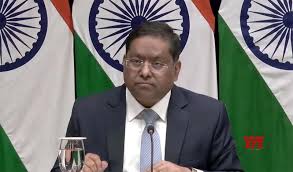
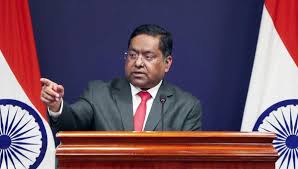
MEA spokesperson Randhir Jaiswal was careful to frame the participation within the bounds of established policy, stating that India supports the Gaza Peace Plan and efforts under UNSC Resolution 2803.
This “observer” status acts as a diplomatic off-ramp, allowing New Delhi to stay in the loop on Gaza reconstruction—an area where Trump has already secured $7 billion in pledges from Middle Eastern nations and a $10 billion commitment from the U.S.—without endorsing the more controversial aspects of the Board’s mandate.
The Board, which includes 27 formal members like Saudi Arabia, the UAE, and Pakistan, has been given a broad remit to tackle “global hotspots,” a term that naturally makes Indian diplomats a bit twitchy given their historical allergy to third-party mediation.
The meeting itself was vintage Trump, complete with “disco beats” and characteristically bold claims that added a layer of surrealism to the proceedings. Most notably, Trump used the platform to repeat his assertion that his personal intervention—specifically a threat of 200% tariffs—prevented a full-scale war between India and Pakistan during Operation Sindoor in May 2025.
While Pakistan’s Prime Minister Shehbaz Sharif, who was in attendance, hailed Trump as a “saviour,” the MEA has consistently maintained that the May 10 ceasefire was a bilateral understanding reached through direct military channels.
By attending only as an observer, India effectively sidestepped the optics of nodding along to these claims while ensuring it wasn’t absent from a table where the future of West Asian stability is being hammered out.
This calibrated engagement comes at a critical juncture, as Prime Minister Narendra Modi is scheduled to visit Israel later this month. For India, the Board of Peace is a “transactional reality”; a peaceful West Asia is essential for the India-Middle East-Europe Economic Corridor (IMEC), yet
New Delhi remains wary of any body that might “almost be looking over” the UN, as Trump put it. The MEA’s stance remains a masterclass in balancing act: supporting the humanitarian and stabilization goals for Gaza while maintaining a safe distance from the “Trump United Nations” rhetoric that has left many European allies and traditional multilateralists in a state of cold sweat.
Ultimately, India’s presence as an observer confirms that while it respects the “art of the deal,” it still prefers the rulebook of international law—even if that book is looking a little dusty these days.
About the Author