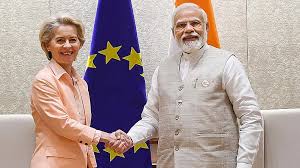
In January 2026, India and the European Union reached the “final stretch” of negotiations for a landmark Free Trade Agreement (FTA), often referred to by Indian Commerce Minister Piyush Goyal as the “mother of all deals.” The breakthrough occurred during a high-profile diplomatic visit by European Commission President Ursula von der Leyen and European Council President António Costa, who served as the Chief Guests for India’s 77th Republic Day celebrations. After nearly 18 years of intermittent talks that began in 2007, both sides used the 16th India-EU Summit on January 27, 2026, to formally announce the conclusion of negotiations, signaling a major shift in global trade dynamics.
Strategic and Economic Rationale
The urgency to finalize the pact was driven by shifting geopolitical realities, specifically the “trade war” and high tariffs imposed by the U.S. administration under Donald Trump. For India, the FTA offers a critical opportunity to diversify its export markets and reduce economic reliance on both the U.S. and China. The EU is already India’s largest trading partner in goods, with bilateral trade reaching approximately $136.5 billion in FY 2024-25. Analysts from the Global Trade Research Initiative (GTRI) suggest the deal could raise India’s trade surplus with the EU by over $50 billion by 2031, with Indian exports potentially accounting for 23% of the total by the end of the decade.
Key Provisions and Exclusions
The agreement is comprehensive, covering goods, services, investment, and digital trade, though it was achieved through a “pragmatic approach” that sidelined the most contentious issues:
Agricultural Safeguards: To protect India’s 450 million farmers and the EU’s sensitive dairy and meat sectors, primary agriculture was largely excluded from the immediate deal. However, processed food products, spices, and beverages are expected to see significant tariff reductions.
Sectoral Gains: India secured zero-duty market access for labor-intensive sectors such as textiles, leather, and handlooms, while the EU gained easier entry for high-end machinery, chemicals, and medical devices.
Automotive Protections: A major point of the “final stretch” involved safeguards for India’s electric vehicle (EV) industry. Indian automakers expressed concerns that Chinese manufacturers might use EU member states as a “backdoor” to ship EVs into India at lower duties. Consequently, the deal includes strict “rules of origin” to ensure that only products with significant European or Indian value-addition benefit from the lower tariffs.
Beyond Trade: A Broader Partnership
The conclusion of the FTA was accompanied by the signing of a Security and Defence Partnership Agreement. This includes a new defense procurement mechanism and cooperation on maritime security, reflecting a shared desire to maintain a “rules-based order” in the Indo-Pacific. By aligning their economies, the world’s two largest democracies are attempting to show a “fractured world” that strategic partnership and open trade remain viable alternatives to rising protectionism. While the formal signing will follow a period of legal vetting and approval by the European Parliament, the political agreement reached in New Delhi marks a historic pivot that anchors India’s long-term export growth and supply-chain integration with Europe.
About the Author